


WEST SYSTEM® | Epoxy Basics 01 of 11
Mixed epoxy passes through a liquid stage, a gel stage and a solid stage. Knowing which stage you are in tells you when to assemble, when to recoat and when to pull the clamps.
Mixing resin and hardener starts a chemical reaction that turns two liquids into a solid. The time that takes is the cure time, and it is governed by two things only: the speed of the hardener and the temperature of the epoxy.
Values from WEST SYSTEM® Epoxy Basics. Guide only — refer to the current technical data sheet for full product specifications and suitability.
Liquid · Gel · Solid
Each resin and hardener combination passes through the same three stages. Only the rate changes. Knowing which stage the epoxy is in tells you what you are still allowed to do to it.
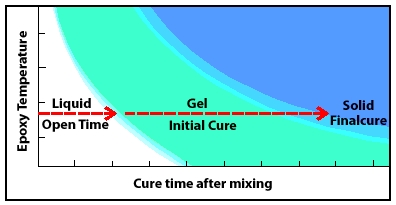
Open time (also called working time or wet lay-up time) is the part of the cure time in which the mixture stays liquid, workable and suitable to apply. All assembly and clamping must take place during the open time to assure a dependable bond.
The mixture enters an initial cure phase — often called the green stage — when it begins to gel, or "kick off". The epoxy is no longer workable and progresses from a tacky gel to the firmness of hard rubber, which you can still dent with a thumbnail.
Because the mixture is only partially cured, a new application of epoxy will still link with it chemically, so the surface can be bonded to or recoated without special preparation. That ability diminishes as the mixture approaches final cure.
The chemical reaction is complete. The mixture has cured to a solid and can be dry sanded and shaped, and you should not be able to dent it with a thumbnail. At this point the epoxy has reached about 90% of its ultimate strength, so clamps can be removed. It will continue to cure over the next several days at room temperature.
A new application of epoxy will no longer link chemically, so the surface must be properly prepared and sanded before recoating to achieve a sound mechanical secondary bond. See Surface Preparation.
Applying modest heat after the epoxy has cured to a solid improves thermal performance and reduces fabric print-through. Talk to ATL's technical team about post-curing your lay-up.
Hardener speed & temperature
Open time dictates how long you have to mix, apply, smooth, shape, assemble and clamp. Cure time dictates how long you wait before removing clamps, sanding or moving to the next step. Two factors set both: hardener cure speed and epoxy temperature.
Each hardener has an ideal temperature range. At any given temperature, every resin and hardener combination goes through the same cure stages, but at different rates. Select the hardener that gives adequate working time for the job, at the temperature and conditions you are working in. The product guide and container labels state hardener pot lives and cure times.
Pot life is the comparison figure: the time a specific mass of mixed resin and hardener stays liquid at a specific temperature — a 100 g mass in a standard container at 22 °C (72 °F). Because it measures a contained mass rather than a thin film, a hardener's pot life is much shorter than its open time.
The warmer the curing epoxy, the faster it cures (Figure 1). The temperature of curing epoxy is the ambient temperature plus the exothermic heat generated by its own cure.
Ambient temperature is the temperature of the air or the material in contact with the epoxy. Air temperature is usually the ambient temperature, unless the epoxy is applied to a surface at a different temperature. Epoxy generally cures faster in warmer air.
Exothermic heat is produced by the curing reaction itself, and how much depends on the thickness or exposed surface area of the mixed epoxy. A thicker mass retains more heat, which drives a faster reaction and more heat again. The shape of the mixing container and the quantity mixed have a large effect. A contained mass of 240 ml (8 fl oz) or more in a plastic cup can generate enough heat to melt the cup and burn skin. Spread the same quantity into a thin layer and the heat dissipates, leaving ambient temperature to govern the cure. The thinner the layer, the slower it cures.
In warm conditions, use a slower hardener where the job allows. Mix smaller batches you can use quickly, or pour the mixture into a container with more surface area — a roller tray, for example — so exothermic heat dissipates and open time extends. The sooner the mixture is transferred or applied after thorough mixing, the more of its useful open time is available for coating, lay-up or assembly.
In cool conditions, use a faster hardener, or apply supplemental heat to raise the epoxy above the hardener's minimum recommended application temperature. A hot air gun, heat lamp or other heat source can warm resin and hardener before mixing, or warm the epoxy after application. At room temperature, supplemental heat is useful when a quicker cure is wanted.
Warning — curing epoxy generates heat. Do not fill voids or cast layers thicker than 12.7 mm (½ in), and thinner again if enclosed by foam or other insulating material. Several centimetres of mixed epoxy in a confined mass, such as a mixing cup, will generate enough heat to melt the cup, burn skin or ignite combustible material if left to stand for its full pot life. Do not use foam or glass mixing containers, and do not pour into confined spaces. If a pot begins to exotherm, move it outdoors immediately, avoid breathing the fumes, and do not dispose of it until the reaction is complete and the mass has cooled.
Heating epoxy that has not yet gelled lowers its viscosity, so it runs or sags more easily on vertical surfaces. Heating epoxy applied over a porous substrate — softwood or low-density core — can also make the substrate outgas and form bubbles in the coating. Wait until the coating has gelled before warming it.
Caution. Never heat mixed epoxy in a liquid state above 49 °C (120 °F).
Whatever steps you take to control cure time, planning the application and assembly before you mix is what actually makes the open time usable.
Working below the hardener's recommended minimum? See Cold Temperature Bonding, or read Ask the Chemist at Epoxyworks.
4 questions
Pot life measures a contained mass — 100 g of mixed resin and hardener in a standard container at 22 °C (72 °F). Open time measures a thin film in use. Because a contained mass holds its own exothermic heat, pot life is always much shorter than open time. Use pot life to compare hardeners; use open time to plan the job.
Yes, while the previous coat is still in the gel stage. A partially cured coat still links chemically with fresh epoxy, so no special preparation is needed. Once it has cured solid, the bond becomes mechanical: wash off any amine blush, sand, and dry the surface before recoating.
At final cure, when the epoxy can no longer be dented with a thumbnail. It has reached about 90% of its ultimate strength at that point and will keep curing over the following days at room temperature.
An uncontrolled exotherm. A contained mass of 240 ml (8 fl oz) or more traps the heat of its own reaction, which accelerates the reaction further. Mix smaller batches, decant into a wide container such as a roller tray, and never cast thicker than 12.7 mm (½ in). If a pot starts to exotherm, move it outdoors and let it cool.
Supplied by ATL Composites
Resin & hardeners
105 Epoxy Resin with 205 Fast, 206 Slow, 207 Special Clear and 209 Extra Slow Hardeners — the hardener choice is how you set open time and cure time for the conditions.
ATL Composites manufactures and distributes WEST SYSTEM epoxy in Australia.
View the WEST SYSTEM rangeGuide only. Refer to the current technical data sheet for full product specifications and suitability. Adapted from WEST SYSTEM instructional material (original guide). Read the product label and the current technical and safety data sheets before use.
Guide 01 of 11
Talk to ATL Composites about your application on +61 7 5563 1222 or [email protected].
WEST SYSTEM® and 105 Epoxy Resin® are registered trademarks of Gougeon Brothers, Inc., USA. Diagrams and instructions courtesy of WEST SYSTEM. Manufactured and distributed in Australia by ATL Composites Pty Ltd.