


WEST SYSTEM® | Epoxy Basics | Guide 09
Two coats of WEST SYSTEM epoxy is the minimum for an effective moisture barrier. Three if the surface will be sanded. Protection keeps increasing up to about six coats, or 0.5 mm (20 mil) of film thickness.
A barrier coat does two jobs at once: it keeps moisture out of the substrate, and it leaves a smooth base for the final finish. Getting there is a matter of roller technique — thin, even films, one small area at a time, tipped off before the epoxy starts to gel.
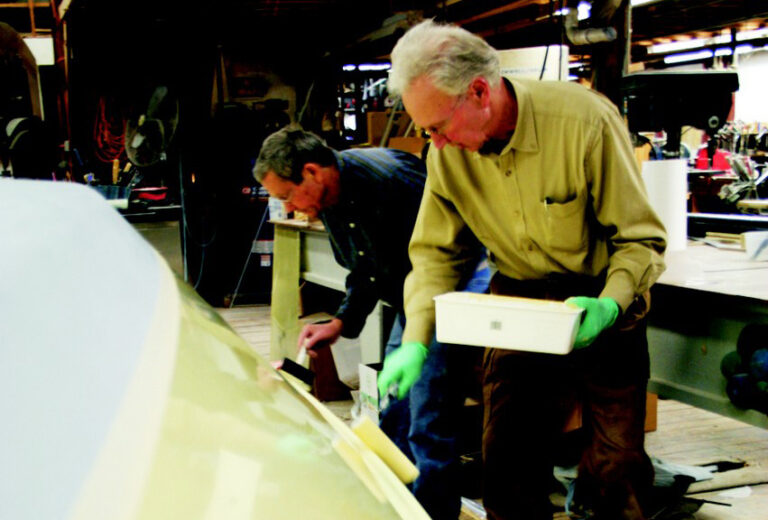
Coating guidance from WEST SYSTEM instructional material. Refer to the current technical data sheet for full product specifications and suitability.
Materials and conditions
Apply a minimum of two coats of WEST SYSTEM epoxy for an effective moisture barrier, or three coats if sanding is to be done. Moisture protection increases with additional coats, up to six coats or about 0.5 mm (20 mil) of thickness. Do not add additives or pigments to the first coat, and do not thin WEST SYSTEM epoxy — mixing thinners with it is not recommended.
Disposable thin urethane foam rollers, such as WEST SYSTEM 800 Roller Covers, give you greater control over film thickness. They are less likely to cause the epoxy to exotherm and leave less stipple than thicker covers. Cut them into narrower widths to reach difficult areas, or for long narrow surfaces such as stringers.
Complete all fairing and cloth applications before you begin the final coating. Allow the temperature of porous surfaces to stabilise before coating — otherwise, as the material warms, air inside it expands and out-gasses through the coating, leaving bubbles in the cured film.
8 steps
Prepare the surface for epoxy bonding — clean, dry and sanded. See Surface Preparation.
Mix only as much resin and hardener as you can apply during the open time of the mixture, and pour it into a roller pan as soon as it is thoroughly mixed.
Load the roller with a moderate amount of the mixture, then roll the excess out on the ramp of the roller pan to get a uniform coating on the roller.
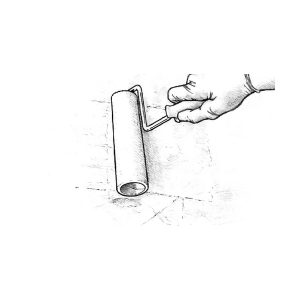
Roll the epoxy lightly and randomly over an area of approximately 600 × 600 mm (2 ft × 2 ft) to transfer it evenly across the area.
As the roller dries out, increase pressure enough to spread the epoxy into a thin even film, extending the coverage area if necessary.
The thinner the film, the easier it is to keep even and the less likely it is to run or sag.
Finish the area with long, light, even strokes to reduce roller marks, overlapping the previously coated area to blend the two together.
Coat as many of these small working areas as you can with each batch. If a batch begins to thicken before it can be applied, discard it and mix a fresh, smaller one.
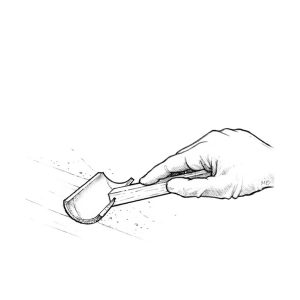
Tip off by dragging a foam roller brush lightly over the fresh epoxy in long, even, overlapping strokes after each batch is applied. Use enough pressure to smooth the stipple, but not enough to remove any of the coating.
Alternate the direction in which each coat is tipped off — first coat vertical, second horizontal, third vertical. An 800 Roller Cover can be cut into segments to make a tipping brush.
Second and subsequent coats
Apply second and subsequent coats following the same procedure. Make sure the previous coat has cured firmly enough to support the weight of the next one.
To avoid sanding between coats, apply all of the coats on the same day. After the final coat has cured overnight, wash and sand it to prepare for the final finish.
Further reading. WEST SYSTEM technical advisor Bruce Niederer's account of using an epoxy barrier coat to stop gelcoat blisters on a 1981 Pearson Flyer appears in Epoxyworks.
4 questions
Two coats minimum, or three if the surface will be sanded. Moisture protection keeps improving with additional coats up to about six, or 0.5 mm (20 mil) of film thickness.
No. Mixing thinners with WEST SYSTEM epoxy is not recommended. Use a thin urethane foam roller cover and spread each load into a thinner film instead.
Not if you apply all of the coats on the same day, while each previous coat is still only partially cured — just firm enough to support the weight of the next. Wash and sand only after the final coat has cured overnight.
Usually out-gassing: a porous substrate warming up after the coating went on, pushing expanding air through the film. Let the temperature of porous surfaces stabilise before coating, and wait until the coating has gelled before applying any heat.
Supplied by ATL Composites
Resin & hardeners
105 Epoxy Resin with 205 Fast, 206 Slow, 207 Special Clear and 209 Extra Slow Hardeners.
Additives
423 Graphite Powder, and 501 and 502 Pigments to tint the mixture — never in the first coat.
Application tools
Roller frames and thin urethane foam covers, mixing sticks, squeegees and static mixers.
Browse the full WEST SYSTEM range supplied by ATL Composites.
View the WEST SYSTEM rangeGuide only. Adapted from WEST SYSTEM instructional material (original guide). Read the product label and the current technical and safety data sheets before use.
Guide 09 of 11
Contact ATL Composites for product-selection support on +61 7 5563 1222 or [email protected].
WEST SYSTEM® and 105 Epoxy Resin® are registered trademarks of Gougeon Brothers, Inc., USA. Manufactured and distributed in Australia by ATL Composites Pty Ltd. Diagrams and instructions courtesy of WEST SYSTEM.