


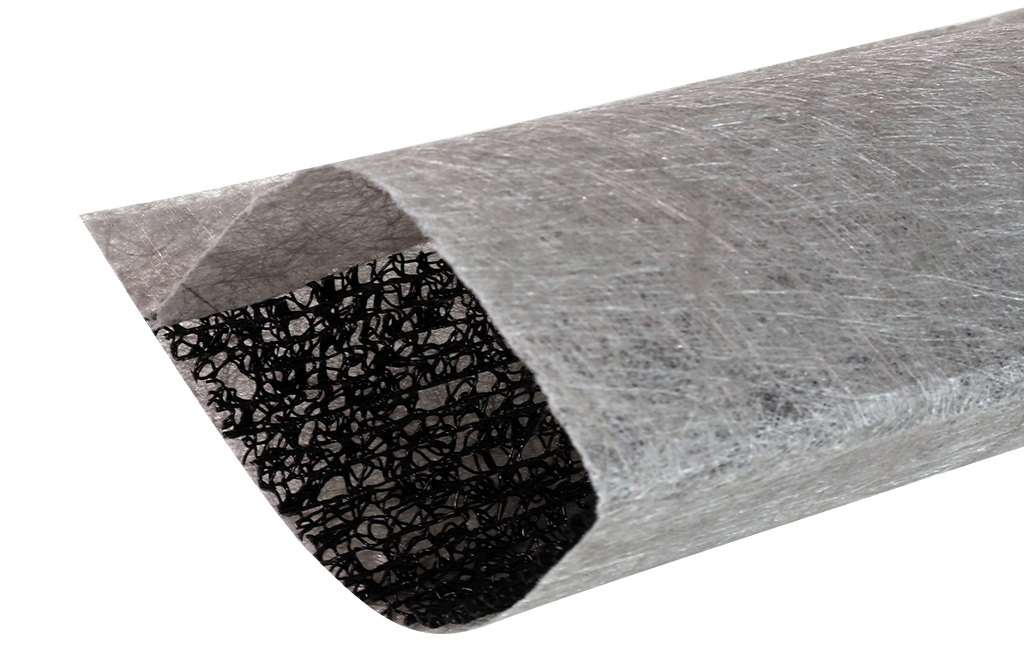
Resin infusion consumables
Resin feed channel and breather strip
A successful infusion depends on two things happening at once: resin reaching every part of the laminate, and air leaving it. These two consumables handle a job each — Flowstrip® carries resin along the length of the part, and Dahlpac® MC79 keeps the air path open at the edges and vacuum line without bleeding resin off.
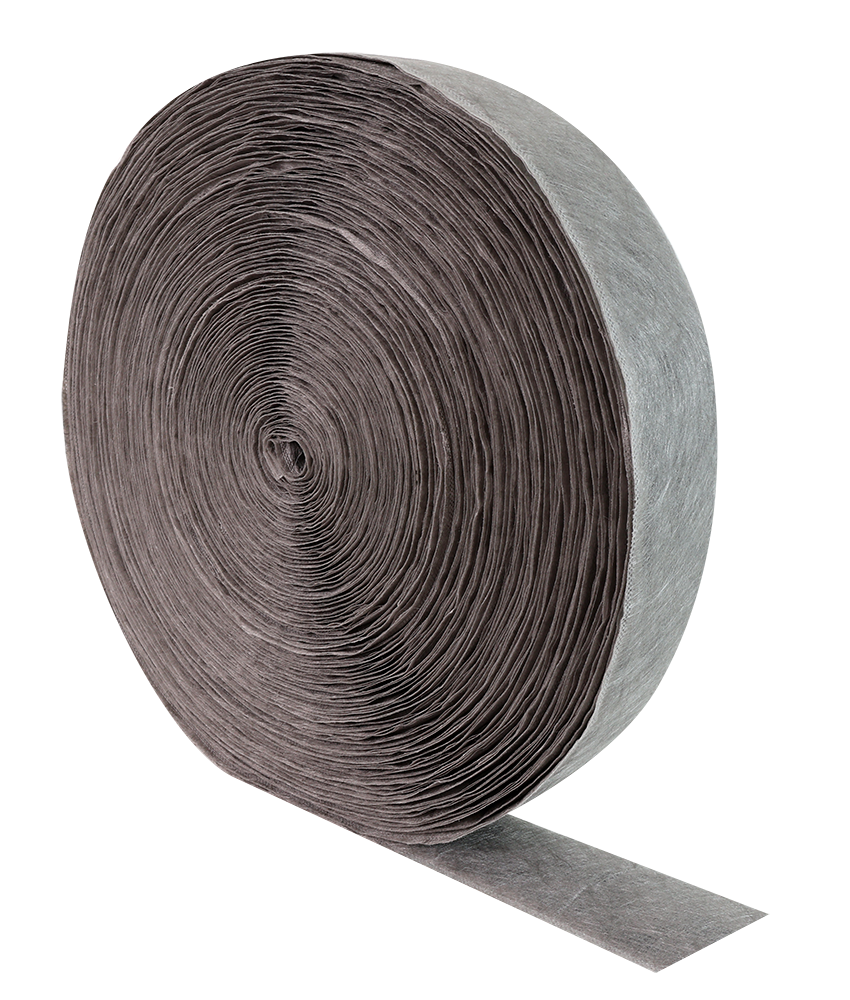 Supplied as100 LM roll of 100 mm lay-flat channel, cut to length on the bench.
Airtech
Flowstrip® Resin Feed Channel
A lay-flat resin feed channel that distributes resin along the full length of the part rather than from a single inlet point. High-flow 3D mesh inside a porous non-woven polyester sleeve — easy to cut, position and vacuum bag, and it connects straight to Airtech infusion fittings.
- Process Temp 155°C
- Width 100 mm
- Roll Length 100 LM
- Part No. P4110
Also in this group — vacuum breather strip
Process
Temp
125°C
Airtech
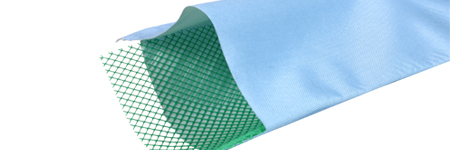
Dahlpac® MC79 Vacuum Breather Strip
A breathable strip combining Dahltexx® SP-2 with Greenflow® 75 to maintain consistent airflow across the laminate without resin bleed-out. It supports complete wet-out, helps prevent dry areas where flow fronts meet and simplifies vacuum bagging with minimal part mark-off.
- 114 mm wide
- 24 LM roll
- Lay-flat tube
- Part V770
| Part | Description | Process Temp | Width MM | Length LM | Form | Best For |
|---|---|---|---|---|---|---|
| P4110 | Flowstrip Lay-Flat Resin Feed Channel | 155°C | 100 | 100 | Lay Flat Tube | Distributing resin along the length of an infusion |
| V770 | Dahlpac MC79 Lay-Flat Tube | 125°C | 114 | 24 | Lay Flat Tube | Edge breathing without resin bleed-out |
Scroll the table sideways to see all columns.
Breather fabrics stocked by ATL
Process
Temp
170°C
ATL
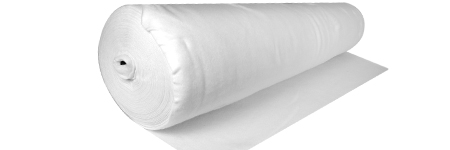
Econobleed – 170°C Breather/Bleeder
A non-woven polyester breather/bleeder with a medium-weight, low-profile and highly drapable construction. It conforms readily over contoured surfaces while supporting effective air evacuation, laminate compaction and controlled resin bleed during room- and elevated-temperature vacuum bagging.
- 1450 mm wide
- 24 LM roll
- Part 0V724
Process
Temp
204°C
Airtech
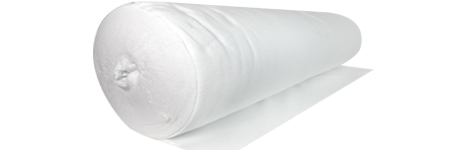
Airweave® N4 – 140 gsm, 204°C
A medium-weight, non-woven polyester breather/bleeder designed for low-pressure curing. Its conformable structure promotes reliable air evacuation and controlled resin bleed across the laminate, supporting consistent compaction and processing performance.
- 140 gsm
- 1520 mm wide
- 96 LM roll
- Part 0V728
| Part | Description | Process Temp | Weight GSM | Width MM | Length LM | Best For |
|---|---|---|---|---|---|---|
| 0V724 | Econobleed: Breather–Bleeder | 170°C | – | 1450 | 24 | Contoured parts and tight radii, where drape matters most |
| 0V728 | Airweave N4: Breather–Bleeder | 204°C | 140 | 1520 | 96 | Higher-temperature cure and longer production runs |
Scroll the table sideways to see all columns.
Breather or bleeder — what is the difference?
The two words are almost always printed together, and most of the time the same fabric does both jobs. They are not the same job.
A breather maintains an air path
It sits between the bag and the laminate stack so air can travel from every part of the laminate to the vacuum connector, rather than being trapped in a pocket where the bag has pulled down tight. Without it you get uneven vacuum and localised voids.
A bleeder absorbs resin
It sits close enough to the laminate to soak up the excess resin driven out under vacuum, which lowers resin content and raises the fibre-to-resin ratio.
What decides which job the fabric is doing is what sits between it and the laminate. Put a perforated release film underneath and resin bleeds through into the fabric — it is acting as a bleeder. Put a non-perforated film underneath and no resin reaches it — it is acting purely as a breather. The fabric is the same; the stack decides.
In resin infusion you almost never want bleed, so the breather goes above a non-perforated film or is kept clear of the laminate entirely, and its only job is the air path to the vacuum line.
How much breather fabric do you need?
Enough to give every part of the laminate a continuous air path to the vacuum connector, with nothing pinched off. In practice that means covering the full laminate plus the run out to the connector, and adding a second layer at the connector itself where airflow concentrates. Sharp corners and deep returns need extra, because that is where the bag bridges and the path closes.
Breather is a consumable, not a component. Budgeting a little more than the part footprint costs less than a bag that will not hold vacuum.
Where breather sits in the stack
Wet lay-up under vacuum
Laminate, peel ply, perforated release film, breather/bleeder, bagging film. The perforation grade of the film controls how much resin the breather draws off, so it is chosen against resin viscosity and the resin content you are targeting.
Resin infusion
Laminate, peel ply, flow media, bagging film — with breather used at the vacuum line and around the edges to keep the air path open rather than across the whole laminate.
One supplier, one technical team. ATL stocks the breather, the peel ply, the release film, the bagging film, the sealant tape and the vacuum fittings — alongside the KINETIX® infusion epoxy systems they are chosen to suit.
Frequently asked questions
What is a resin feed channel and do I need one?
A resin feed channel distributes resin along the length of a part during infusion rather than at a single point. Flowstrip® is a lay-flat channel that cuts to length, vacuum bags flat and connects to Airtech infusion fittings.
What is breather fabric used for?
Breather fabric maintains an air path from every part of the laminate to the vacuum connector, so vacuum is even across the whole part and air is not trapped where the bag pulls down tight.
What is the difference between a breather and a bleeder?
A breather maintains the air path. A bleeder absorbs excess resin. The same non-woven polyester fabric usually does both — what decides which job it is doing is the film underneath it. Perforated release film lets resin through and the fabric bleeds; non-perforated film blocks resin and the fabric breathes only.
Do I need breather fabric for resin infusion?
Yes, but used differently. In infusion you do not want resin bleeding into the breather, so it is generally kept above a non-perforated film or confined to the vacuum line and edges, where its job is purely to keep the air path open.
How much breather fabric do I need?
Enough to cover the laminate and run out to the vacuum connector with no pinch points, plus an extra layer at the connector where airflow concentrates. Sharp corners and deep returns need more, because that is where the bag bridges.
What weight breather should I use?
Heavier fabrics carry more air and absorb more resin; lighter fabrics drape better over contours. Econobleed is the low-profile, highly drapable option; Airweave® N4 at 140 gsm suits low-pressure curing and higher-temperature work.
What temperature can breather fabric take?
Match it to the peak temperature the laminate will reach, including exotherm — not the ambient shop temperature. Econobleed is rated to 170 °C and Airweave® N4 to 204 °C.
Talk to ATL about your application
Tell us the part, the resin system and the cure schedule, and we will recommend a breather grade, width and quantity that suits.
or call +61 7 5563 1222